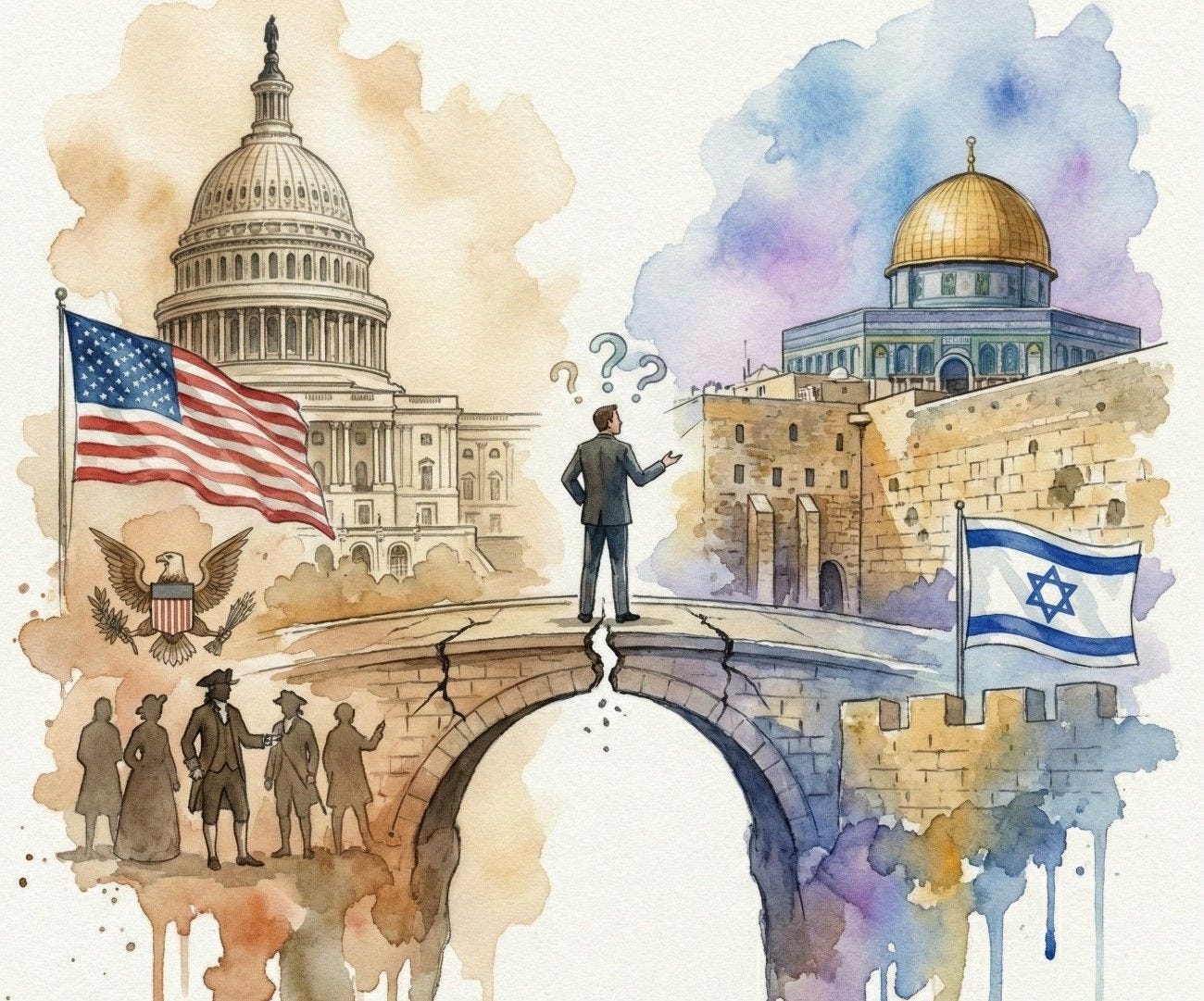
Mike Huckabee’s Israel Problem
And America's
Mike Huckabee’s Israel Problem — And America’s
When Mike Huckabee sat down with Tucker Carlson at Ben Gurion Airport this week, it was supposed to be a conversation about faith, geopolitics and the U.S.–Israel relationship. Instead, the interview has become a litmus test for where an American ambassador’s first allegiance truly lies.
In a sprawling, combative exchange, Huckabee — the U.S. ambassador to Israel and a longtime Christian Zionist — went far beyond standard pro‑Israel talking points. At one point he said it would be “fine” if Israel took control of all the land described in the biblical covenant “from the river of Egypt to the great river, the Euphrates,” a zone that in modern terms would swallow large parts of the Middle East. When Carlson pressed him on civilian deaths in Gaza and on whether Israel was drifting toward genocidal logic, Huckabee’s instinct was not to create distance but to defend, rationalize and reframe.
The result was less the posture of a U.S. envoy representing American interests abroad than that of a political client fiercely protecting his host government.
The interview that blew up
The confrontation did not come out of nowhere. Carlson has recently repositioned himself as one of the loudest “America First” critics of the U.S.–Israel relationship, arguing that Washington is too deferential to the Israeli government and that criticism of Israel is stigmatized or censored. Huckabee, stung by Carlson’s earlier segments on the treatment of Christians in Israel, invited him to come and see the country for himself.
What the audience saw, however, was not a calm tutorial but a clash of two worldviews.
On territory, Carlson pointed to Genesis 15:18 and asked the obvious question: if Huckabee insists God granted this land to the Jewish people, does that imply Israel has a moral right to annex swaths of Jordan, Syria, Lebanon, Iraq and beyond? Huckabee replied, “It would be fine if they took it all,” then quickly tried to walk that back as “an exaggerated remark” while insisting Israel is not actually seeking to conquer that territory and only wants to keep what it now holds.
On Gaza, Carlson read out biblical passages about Amalek and asked how Prime Minister Benjamin Netanyahu’s use of that language could be interpreted as anything other than a call to genocide. Huckabee flatly rejected the premise, arguing that if Israel had truly wanted genocide, it “could have done it in two-and-a-half hours,” given its military power, and insisting that the Israel Defense Forces had gone to great lengths to spare civilians.
Pressed again on children killed in Gaza, Huckabee suggested that minors who “supported Hamas” or “fought Israel” were legitimate targets — a line Carlson met with undisguised horror, responding, “I would not kill children, period. And I wouldn’t make excuses for killing children either.”
Whose ambassador is he?
Diplomats are supposed to advocate for their country, but also to exercise judgment and maintain some daylight between themselves and their host government. Huckabee’s performance made that line almost impossible to see.
Throughout the conversation, Carlson accused him, in effect, of prioritizing Israel over the United States — on questions of war with Iran, on the legacy of the Iraq War, on the presence of convicted spy Jonathan Pollard in Israel, and on the broader tilt of U.S. foreign policy. Huckabee responded with the talking points of a seasoned pro‑Israel advocate: Israel does not drag the U.S. into wars it does not want; American troops have never fought “for” Israel; Iran is an American enemy on its own terms; and military aid to Israel delivers a huge “return on investment.”
There is nothing inherently illegitimate about an ambassador defending a close ally. The problem here is one of tone, framing and hierarchy. At key moments Huckabee spoke less as the guardian of an American national interest that happens to include Israel, and more as a theological salesman for the maximalist claims of the Israeli right.
His comfort with the idea that it would be “fine” for Israel to annex an area “essentially covering the entire Middle East,” even if later qualified, was not the language of a cautious U.S. diplomat in a volatile region. It was the language of a movement that views ancient scripture as superior to international law and current borders — and expects Washington to bend accordingly.
Theology over policy
Huckabee’s remarks are a textbook case of what happens when personal theology blurs into public policy.
As an evangelical Christian, he has for years argued that Jews possess a biblical entitlement to the land of Israel and has supported Israeli sovereignty claims over the occupied West Bank. Now, as ambassador, that conviction appears to shape not only his rhetoric but his tolerance for Israeli state violence. When the Gaza war is framed primarily as a matter of Israel’s 3,800‑year‑old connection to the land and Americans’ supposed moral duty to back that story, the lives of Palestinians — including children — are reduced to a grim footnote.
That framing also diminishes American voters. Carlson, drawing on his “America First” line, argued that Prime Minister Netanyahu wields more influence over U.S. foreign policy than ordinary Americans do and that Washington too often takes the Israeli government’s side over its own citizens.Huckabee rejected that, but he did little to articulate a vision of U.S. interests that stands apart from the priorities of the current Israeli leadership.
In practical terms, an ambassador who leads with God’s land covenant and the righteousness of the IDF — and only secondarily with U.S. law, treaty obligations and democratic accountability — is signaling to both Israelis and Americans that his primary emotional allegiance lies with his host country’s narrative.
A Republican and evangelical split
The interview also exposed the widening rift on the American right. For decades, evangelical support for Israel was one of the most stable pillars of U.S. Middle East policy. Now, younger conservatives and some populist voices question that consensus, pointing to Gaza, to lobbying power in Washington and to the risk of another war with Iran.
Israeli and evangelical leaders have already been working to shore up that relationship, organizing mass trips for pastors and influencers to Israel to counter growing skepticism. Huckabee, in that context, is both ambassador and symbol — the man who stands at the intersection of Christian Zionism and American state power.
By choosing to meet Carlson’s criticisms with near‑total theological and political alignment with Israel’s government, he likely reassured the already‑convinced. But he also reinforced the very caricature Carlson is selling: an American official who seems more animated by defending Israel’s reputation than by grappling with the moral and strategic costs of unconditional support.
The disgrace is the shrug
Reasonable people can disagree over where to draw lines in the U.S.–Israel relationship: how much aid, what conditions, how to handle Iran, what to say about settlements or the West Bank. That debate is overdue, not dangerous.
What felt most jarring in Huckabee’s remarks was not that he supports Israel — that is hardly news — but the apparent ease with which he brushed past the hardest questions. If it would be “fine” in theory for Israel to take all the land from the Nile to the Euphrates, what does that say to millions of non‑Jews currently living there? If killing children who are deemed “complicit” can be rationalized, what does that do to America’s own moral vocabulary about war and civilian protection?
An ambassador who shrugs at those implications does a disservice to the country he represents. The job is not to be a “pet” of the host government, nor a traveling preacher for someone else’s theology, but a steward of American interests and values — including the uncomfortable ones.
Sources:
https://www.axios.com/2026/02/20/tucker-carlson-mike-huckabee-israel-middle-east
https://www.trtworld.com/article/51a0af83a11b
https://www.jpost.com/american-politics/article-887379
https://www.washingtonpost.com/nation/2026/02/20/tucker-carlson-mike-huckabee-israel-middle-east/
https://singjupost.com/mike-huckabees-interview-tucker-carlson-show-transcript/


