


Not an Unknown Man
For a day or two, the headline spread quickly: a nearly blind refugee from Myanmar was discovered deceased on a Buffalo sidewalk, having been left alone by immigration agents at a coffee shop miles from his residence days prior. On a freezing winter night, a 56-year-old man with limited English and poor vision was released and driven to a closed Tim Hortons, then left in thin jail booties to manage on his own.
And then, very quickly, it felt like the story moved on. A few news cycles, a handful of statements, and the world returned to its usual noise. A man who had survived statelessness, camps, and decades of waiting died in a downtown American city, and it was as if his life weighed nothing on the scales of public outrage. His family’s grief, their shattered American dream, seemed to vanish into that silence.
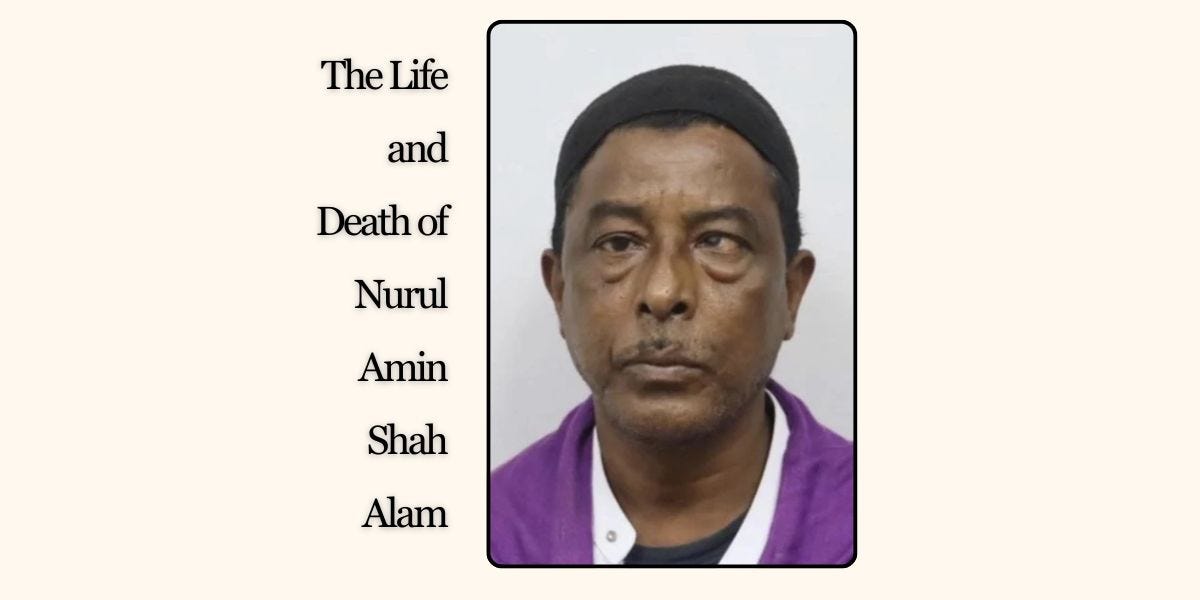
But he was not just “a nearly blind refugee.” He had a name, a history, and people who loved him. His name was Nurul Amin Shah Alam.
A Man Who “Didn’t Matter”: Nurul Amin of Arakan
Shah Alam belonged to the Arakan Rohingya, a Muslim minority from Rakhine (Arakan) State in Myanmar that has lived for generations without recognized citizenship. Successive governments stripped Rohingya people of legal status, restricted their movement, and enabled campaigns of violence so severe that United Nations officials and human rights groups have described them as possible genocide. [1]
In 2017, over 700,000 Rohingya were driven from Myanmar into neighboring Bangladesh in what became one of the world’s largest refugee crises; many others, like Shah Alam’s family, scattered to countries such as Malaysia in search of survival. Their lives were already defined by statelessness and displacement well before Buffalo was ever mentioned.
Twenty years in Malaysia, ten years in the resettlement line
Shah Alam and his wife, Fatimah Abdul Roshid, spent roughly two decades in Malaysia, working and raising their family in the gray zone that so many refugees know too well: tolerated, but never secure. Community advocates later said he worked in construction for years, awaiting a durable solution while trying to build something like a normal life on borrowed time. [2]
In 2014, they entered the long, bureaucratic process of the U.S. refugee resettlement system. It took about a decade for that application to bear fruit. By the time approval came through, the family would have to fracture: Shah Alam would travel to Buffalo with Fatimah and two of their sons, while other family members remained behind, still waiting for their turn.
Shah Alam arrived in Buffalo, New York, on December 24, 2024, officially admitted as a legal refugee. He landed not as an “illegal immigrant” or a border crosser, but as someone the U.S. government itself had invited in after years of vetting. The dream was simple and achingly ordinary: reunite the family, sit at one table again, eat Fatimah’s home-cooked food, and spend the rest of his life in safety. [2]
A walk gone wrong
On February 15, 2025, approximately seven weeks into his new American life, Shah Alam went out for a walk with a curtain rod he had bought and was using as a makeshift cane. He became disoriented just a few blocks from his home and wandered onto or near the wrong property. A resident, alarmed, called 911 to report a suspicious man in her yard. [3]
What happened next is on video. Buffalo police body-camera footage, published by Investigative Post, captures the encounter: officers shouting, “Drop it! Put it down! You’re going to get tased. I’m going to shoot you, dude,” at a man who does not respond in English and does not appear to understand the commands. When he moves toward them still holding the rod, they fire Tasers, knock him to the ground, and cuff him in the snow. [3]
In the struggle, officers say he bit two of them, a detail they repeat on camera as they discuss documenting injuries. The severe charges he faced included felony assault on an officer, burglary or trespass, criminal mischief, and criminal possession of a weapon – the very object he had used to navigate the snowy city. Federal immigration authorities quietly added another layer: an immigration detainer, instructing the jail to alert them before any release. [3] (Continues below)
A year in jail while his family waited
For the next twelve months, from February 2025 to February 2026, Shah Alam sat in the Erie County Holding Center on those charges. His family did not post bail for most of that year. According to his attorney and community advocates, they were terrified that if he stepped out of the county jail, ICE or Border Patrol would take him, move him to a distant detention center, and possibly deport him to the very dangers they had fled. [3]
So they chose what felt, in that moment, like the lesser of two cruelties: leave him inside a county jail they could at least reach by bus, visit him regularly, and wait for the criminal case to resolve. For a nearly blind man who could not read the notices handed to him and who needed interpreters to communicate, it meant a lost year in a concrete world.
A plea deal that was supposed to protect him
As 2025 turned to 2026, the wheels of justice finally began to move. On February 9, 2026, nearly a year after his arrest, a deal finally arrived. Prosecutors dropped the felonies; Shah Alam pleaded guilty to two misdemeanors—trespass and fourth-degree criminal possession of a weapon—and a sentencing date was set for March 24, 2026. The Erie County district attorney later said the plea considered both his lack of prior record and the harsh immigration consequences a felony could trigger. [4]
His Legal Aid lawyer told the family that now, with only misdemeanors and a sentencing date on the calendar, it was safer to post bail. No one expected miracles. The hope was modest: he would be processed, maybe briefly held in immigration custody, then released to continue his case from outside the cell.
Bail, but not freedom
On February 19, 2026, Fatimah and the children scraped together $5,000 in bond and went to the Erie County Holding Center. They handed over the money and then waited in the lobby for Shah Alam to come through the doors. Instead, because of the old immigration detainer, the Sheriff’s Office called U.S. Border Patrol, and at about 4:39 p.m. agents took him from the jail into their own custody. [2]
Border Patrol later said that when they reviewed his file, they realized he had entered the United States as a refugee on December 24, 2024, and was “not amenable to removal”—in plain language, someone they should not deport.
This determination was bureaucratic language for a simple fact: as a legally admitted refugee, Shah Alam had the right to remain in the United States. He was not deportable. There was no legal reason to keep him in federal custody. The decision to release him was correct; the manner of that release was not.
Border Patrol claims they used a translation app, offered him a phone call (which they say he declined), and then gave him a “courtesy ride” instead of simply releasing him from their office. [2]
The “courtesy ride” to nowhere
What Border Patrol did next would seal his fate.
The “courtesy ride” took Shah Alam to a Tim Hortons in a strip plaza on Niagara Street in Buffalo. Border Patrol has described it as a “warm, safe location near his last known address.” Surveillance footage tells a different story: the Tim Hortons had already closed for the night, and he was dropped there after dark in late February, in winter temperatures, more than four miles from the East Side apartment where his family now lived. [5]
Video obtained by news outlets shows a white van pulling into the parking lot and a man in orange jail-issue booties stepping out, pulling his hood tight and walking away alone into a nearly empty plaza. He had no phone, no English, and almost no vision. Border Patrol agents did not call his wife, his sons, or his lawyer to tell them where he was. [5]
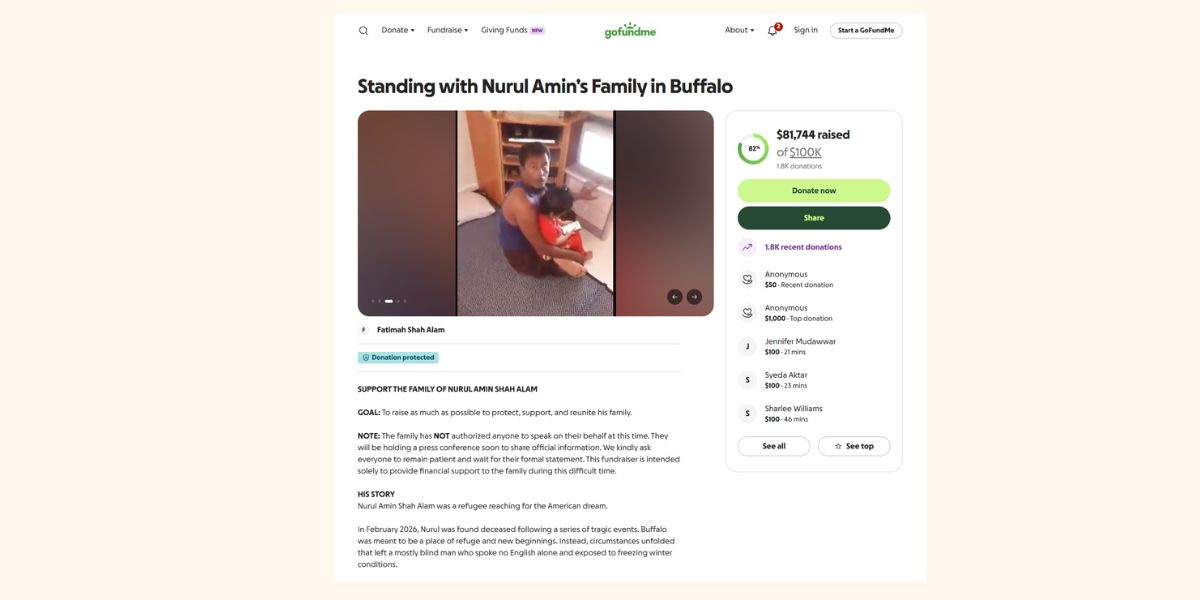
Back at the jail, Fatimah and the children were still waiting in the lobby, not knowing that the man they had just bailed out had already been driven across town and left outside a closed coffee shop.
(Continues below)
Four days missing
Over the next several days, the family and members of Buffalo’s Rohingya community searched for him around the city. His attorney, unable to find him in federal detainee databases, worried he might be lost in the system or on the street; on February 22, 2026, he filed a missing-person report with the Buffalo Police Department. [6]
Police entered Shah Alam into state and national databases as a missing person. On February 23, a detective, after hearing (incorrect) information that he was in federal custody, briefly marked the local case “closed” in the department’s software—a bureaucratic misstep that did not remove his name from national systems but shows how tangled the lines of communication had become. When it became clear that Border Patrol no longer had him, the case was reopened the same day. [6]
By February 24, detectives had talked to a former neighbor and then to one of his sons, confirming that the family had not seen him since the day of his release and learning, finally, that Border Patrol had left him at the Niagara Street Tim Hortons. [6]
Found on Perry Street
That evening, February 24, 2026, a woman near 56 Perry Street, in downtown Buffalo’s entertainment district, saw a man she later identified as Shah Alam moving around outside at about 5:30 p.m.. Roughly three hours later, at around 8:30 p.m., she found him lying on the ground, unresponsive, and called 911. [6]
Firefighters and paramedics tried to revive him; police administered Narcan; he was pronounced dead at the scene. City surveillance cameras that might have captured his last movements were offline because they had recently been vandalized, leaving a blank where the final hours of his life should have been. [9]
The Erie County Medical Examiner’s Office identified the body as Nurul Amin Shah Alam on February 25, 2026 and notified his family. City officials initially told reporters that his death was “health-related in nature” and that homicide and death purely from exposure had been ruled out. However, the Medical Examiner’s Office later clarified that the cause of death had not yet been determined and that the investigation remained ongoing. As of late February 2026, the official cause of death has not been publicly released. [6]
A funeral, and a city that calls itself welcoming
On February 26, 2026, mourners carried Shah Alam’s body into Masjid Zakariya on Sobieski Street for his funeral prayers, then to a cemetery on Stone Street, where about a hundred people—Rohingya neighbors, other refugees, and long-time Buffalo residents—gathered to bury him.
Buffalo’s mayor, Sean Ryan, issued an unusually sharp statement. He called Border Patrol’s decision to leave Shah Alam at a closed coffee shop on a snowy night “unprofessional,” “inhumane,” and a “dereliction of duty”, and said the death was preventable. [7]
Representative Tim Kennedy called the case a “horrific and heartbreaking tragedy,” urged a full investigation, and wrote to New York Attorney General Letitia James asking her to examine the conduct of Border Patrol, the county jail, and local agencies. [8]
Buffalo likes to think of itself as a welcoming city for refugees, a Rust Belt town that has opened its doors to families from Somalia, Syria, Myanmar, and beyond. For many in that community, watching a man like Shah Alam die this way felt like a crack in that self-image.
A death in the shadow of politics and bureaucracy
Was Nurul Amin Shah Alam a victim of the broader political climate, of a country where anti-immigrant rhetoric and cruelty at the border have become routine talking points? Was he simply the casualty of a chain of incompetence and negligence—a police response that escalated instead of helping, a jail that defaulted to calling federal agents, a federal agency that chose a “courtesy ride” to a dark plaza over the simple act of phoning his family?
The honest answer is that the public record does not give us a neat motive. What it shows, across documents and videos, is a series of small decisions that, together, stripped this man of the protections he should have had:
A police encounter that treated a nearly blind man with a makeshift cane as a lethal threat instead of a lost neighbor.
A year-long detention that turned a language barrier and confusion into a felony case and an immigration detainer.
A release process that valued clearing a detainer over reuniting a family in the lobby just a few feet away.
A “courtesy ride” that ended not at home, not at a shelter, not even at a police precinct, but outside a closed coffee shop.
Whatever labels we choose — systemic failure, bureaucratic indifference, the quiet violence of low expectations for refugee lives — the result is the same. A man who survived genocide, statelessness, and two decades in exile reached the country that promised him safety and died on cold concrete, alone.
A personal note
I have tried to write this piece several times and kept stopping. It is hard to hold the cold language of “custody transfer,” “detainer,” and “health-related death” alongside the image of a father who only wanted to sit at one table with his wife and children and enjoy a meal together, in peace. It is hard not to feel that, somewhere in the machinery of law and enforcement, his life was treated as disposable.
The least we can do is say his name, tell his story truthfully, and refuse to treat his death as just another line in the news. I know there is so much much more going on in the world right now and that also matters but this man deserved a lot more from his new hosts.
References
[1] Al Jazeera. (2026, February 26). Near-blind Rohingya refugee dies after US agents left him far from home.
https://www.aljazeera.com/news/2026/2/26/near-blind-rohingya-refugee-dies-after-us-agents-left-him-far-from-home
[2] CNN. (2026, February 27). Key questions surround the death of a nearly blind refugee after he was released by Border Patrol in New York.
https://www.cnn.com/2026/02/27/us/shah-alam-death-new-york-border-patrol-wwk-hnk
[3] Investigative Post. (2026, February 25). Blind refugee abandoned by Border Patrol is dead.
https://www.investigativepost.org/2026/02/25/blind-refugee-abandoned-by-border-patrol-is-dead/
[4] The New York Times. (2026, February 27). Nearly blind refugee is found dead after Border Patrol drops him at Buffalo Tim Hortons.
https://www.nytimes.com/2026/02/27/nyregion/myanmar-refugee-buffalo-border-patrol.html
[5] Syracuse.com/ Associated Press. (2026, February 27). Video shows nearly blind refugee left by Border Patrol at closed Buffalo shop.
https://www.syracuse.com/state/2026/02/video-shows-nearly-blind-refugee-left-by-border-patrol-at-closed-buffalo-shop.html
[6] WKBW, Buffalo. (2026, February 26). Community mourns man who was found dead after he was mistakenly taken into custody by CBP, then released.
https://www.wkbw.com/news/local-news/buffalo/community-mourns-man-who-was-found-dead-after-he-was-mistakenly-taken-into-custody-by-cbp-then-released
[7] City of Buffalo. (2026, February 26). Statement from Mayor Sean M. Ryan on Death of Nurul Amin Shah Alam.
https://www.buffalony.gov/CivicAlerts.aspx?AID=1614
[8] U.S. Congressman Timothy M. Kennedy. (2026, February 26). Kennedy calls for comprehensive investigation into death of Rohingya refugee in Buffalo.
https://kennedy.house.gov/news/documentsingle.aspx?DocumentID=2372
[9] WGRZ Local News - Buffalo Police offer timeline of events following Nurul Amin Shah Alam’s death.
https://www.wgrz.com/article/news/local/nurul-amin-shah-alams-death-timeline-buffalo-police/71-19fe1511-b558-4df6-990a-167cd89b27e1
Originally published at https://munvaray.com/