

Why Millennials Are the Last Generation to Bridge Two Cultural Eras
Throughout human history, each generation has typically passed on knowledge and responsibilities to the next, much like a relay race.

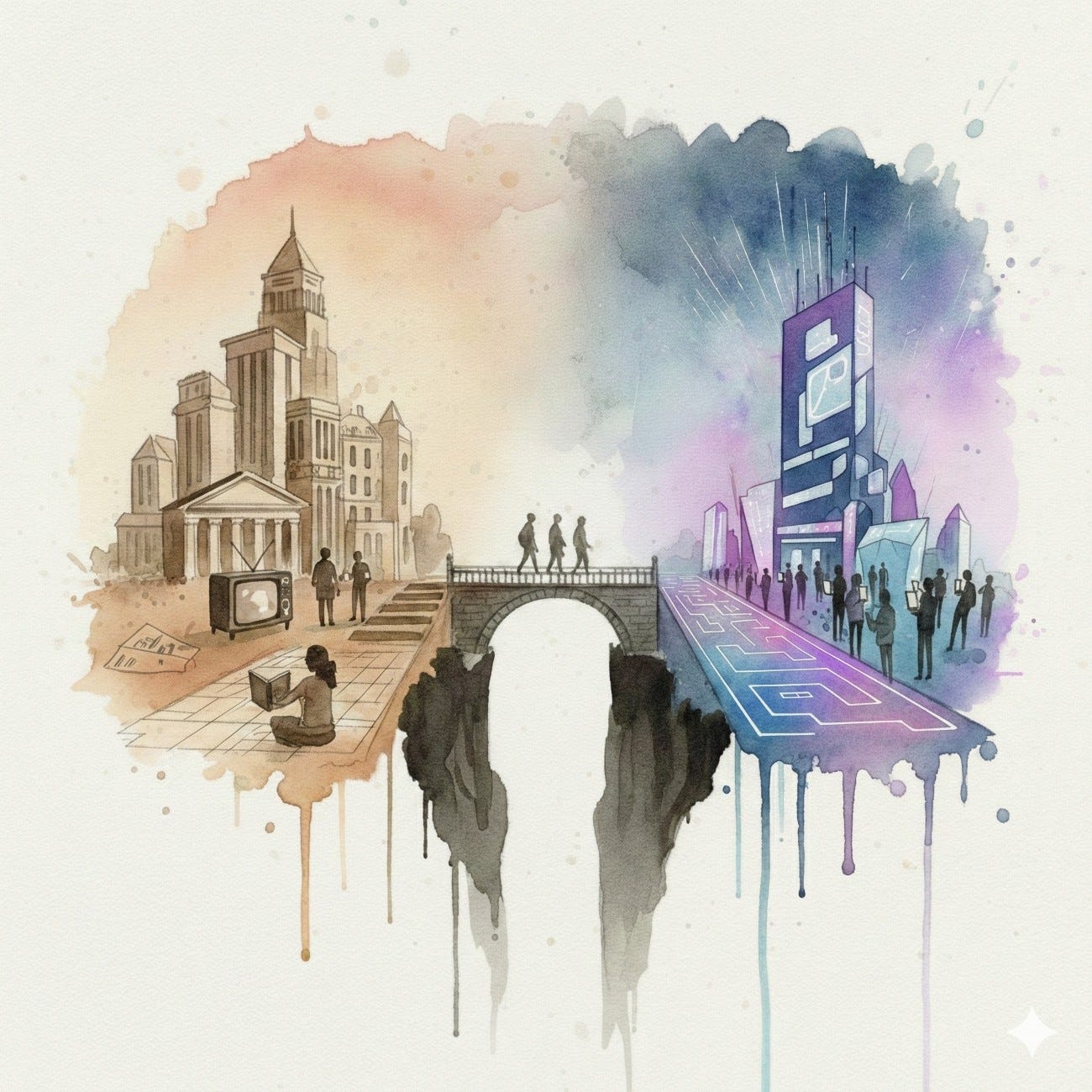
Why Millennials Are the Last Generation to Bridge Two Cultural Eras.
Throughout human history, each generation has typically passed on knowledge and responsibilities to the next, much like a relay race. The baton is passed from one runner to the next, with consistent speed and direction, even if their shoes are different. However, recently, it appears the course has been completely changed.
Many Millennials experience an almost instinctual connection to the preceding generations, the Boomers and Gen X. However, when we consider the newer generations, there’s a feeling of a growing divide. This isn’t merely a cliché about younger generations, anymore.
The Shift from Vertical to Horizontal Transmission
To understand this, we have to look at how information travels. Sociologists often discuss “Cultural Transmission”—the process by which a society’s heritage is passed across generations. Historically, this was transmitted vertically (learning from parents, elders, and legacy institutions).
Millennials came of age as the “Broadcasting Era” was drawing to a close. We watched the same sitcoms our parents did, listened to the radio, and sourced our news from the same few outlets. This created a shared vocabulary. Even if we rebelled against our parents’ values, we were rebelling against a framework we both understood.
Newer generations, in contrast, are at the forefront of the “Narrowcasting Era,” a period defined by horizontal transmission.
Owned Media: Beyond just consuming media, their engagement involves a more active and involved relationship with it.
Sovereign Learning: Education is no longer a top-down handoff. When a Gen Z or Gen Alpha creator needs to learn a skill, they don’t look for a legacy institution; they look for a peer creator who speaks their specific “digital” dialect.
The Phenomenon of “Generational Amnesia”
Psychologist Peter Kahn describes a concept called “Environmental Generational Amnesia.” It suggests that each generation takes the world they were born into as the “normal” baseline, often unaware of what came before.
For Millennials, the normal included a sense of historical context. Needing to go back to understand the present. But for newer generations, the baseline is a world of fragmented, real-time data. They aren’t “forgetting” the shared media of the past; they simply don’t see it as a requirement for social connection.
They’ve built a sovereign culture. This culture doesn’t need to look back. It’s too busy building its own future. It does this efficiently in 9:16 vertical video, or maybe 6:7.
The Fading Bridge
The Brookings Institution often refers to Millennials as a demographic bridge. We are probably the last generation to experience both the analog past and the digital present. We can sit with a Gen X’er and discuss a film from 1985 because that film remained a pillar of the zeitgeist for decades. They watched it. We watched it too. Back then, we watched it over and over, as media was pretty scarce. However, for the newest generations, a “pillar” might only last for a two-week viral cycle.
While not necessarily an architectural flaw, this decoupling signifies a major transition. Newer generations’ independence fosters creativity and challenges old norms but may lead to a loss of shared history.
As Millennials, we act as a sort of translator between the analog past and the hyper-digital future. But translation only works if there is a record to look back on. Therefore, we need to write and document our perspective more frequently. If we don’t put these observations down, that transition knowledge just fades out, and the connection between where we came from and where we are going gets lost in translation.
Love
-MunVaRay
Sources & References
Environmental Generational Amnesia: Kahn, P. H. (University of Washington)
The Demographic Bridge Concept: The Brookings Institution - Millennials as a Bridge
Horizontal vs. Vertical Transmission: Stanford Encyclopedia of Philosophy - Cultural Evolution
Media Consumption Shifts: Pew Research - Gen Z and Social Media as News Sources
First published on: munvaray.com
Documenting things down is a strong advantage for humans as a species. We can communicate across time. Across generations. Across geography.
Other animals only have direct vertical transmission with their immediate peers.
Whether future generations choose a combination of vertical plus horizontal or mainly become horizontal will be interesting to observe.
Very interesting post.